Databricks Launches Multi-Statement Transactions
Databricks released general availability for multi-statement transactions across Delta Lake and Iceberg tables, allowing complex warehouse workflows directly on the lakehouse.
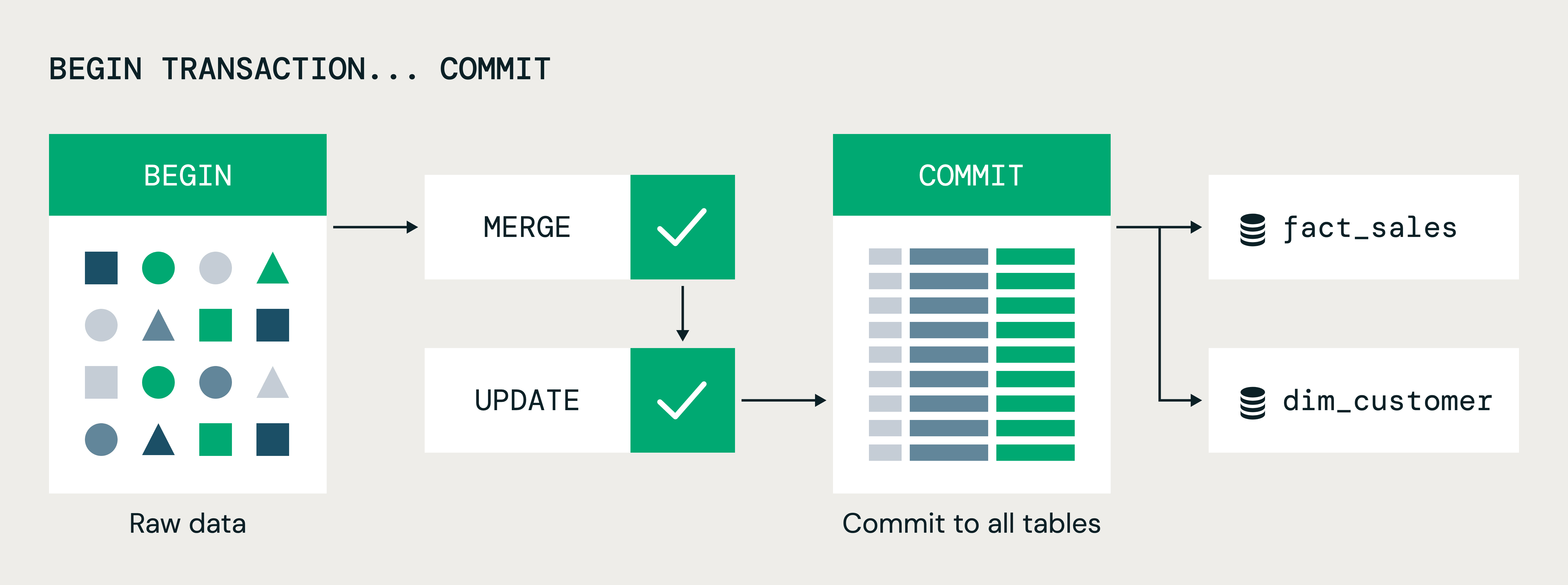
Databricks has announced the general availability of multi-statement transactions natively supported across both Delta Lake and Apache Iceberg open table formats. Managed via Unity Catalog, the update enables multi-statement, multi-table transactional guarantees, ensuring complex workflows either complete entirely or roll back cleanly without requiring separate data warehouse systems. Unlike legacy systems that serialize writes with table-level locks, Databricks utilizes row-level concurrency, allowing parallel write operations to the same table when distinct rows are modified.
The transactional framework integrates fully with warehousing development features, including SQL scripting, temporary tables, stored procedures, and streaming tables. Developers can implement Write-Audit-Publish patterns by holding intermediate data, inspecting schemas with commands such as DESCRIBE TABLE, SHOW COLUMNS, and GET DIAGNOSTICS, and publishing validated datasets atomically. Governance remains unified, as Unity Catalog security policies—including row-level security and column masking—apply automatically to both reads and writes.
Early enterprise adoption highlights the operational benefits for data teams. Automated data integration platform Fivetran uses the feature in its History Mode to handle slowly changing dimension (SCD) Type 2 updates, executing destination writes for closing prior record versions and inserting active ones within a single atomic commit. Similarly, health benefit service platform Accolade leverages multi-statement transactions to process roughly 1,700 production updates every day for incoming claims and liabilities workflows.
For data engineering teams, bringing native multi-table transactional consistency directly to open lakehouse formats eliminates the need to maintain duplicate data copies in proprietary data warehouses. This reduces system latency, lowers storage overhead, and removes the complex reconciliation code traditionally required to handle partial failure modes. Furthermore, downstream pipelines reading from continuous ETL streams can now reliably avoid processing incomplete or unvalidated data updates.
This is our own summary of reporting by Databricks AI



