MLX Port Fits Alibaba Qwen3.8-27B on 24GB Macs
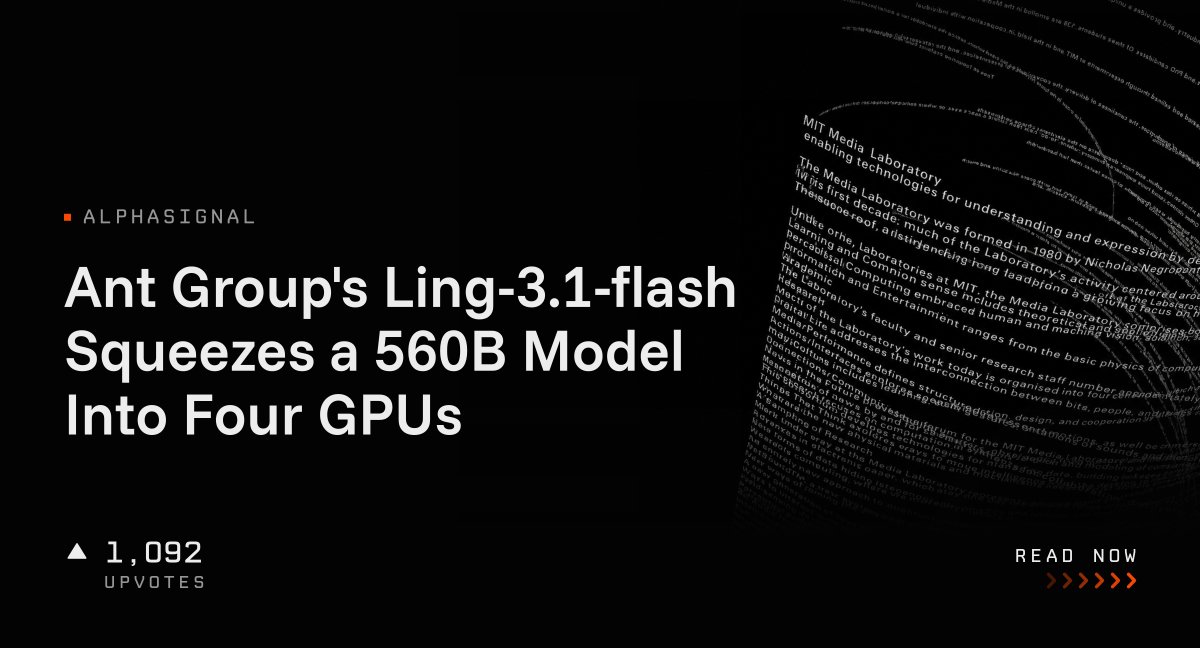
The mlx-community has released a 4-bit MLX conversion of Alibaba's Qwen3.8-27B, allowing developers to run the 27-billion parameter multimodal model locally on 24 GB Mac hardware.
The mlx-community organization has published a 4-bit MLX build of Alibaba's Qwen3.8-27B model, making heavy multimodal AI available on local Apple silicon devices. The release has already crossed 800,000 downloads, though Hugging Face metrics may count automated pulls alongside individual users. By shrinking the original 55.6 GB BF16 checkpoint down to roughly 16 GB using 4-bit group-64 affine quantization, the team has enabled local execution on Mac systems equipped with 24 GB or 32 GB of unified memory.
Under the hood, Qwen3.8-27B is a 27-billion-parameter dense model from the Qwen3.5 family, meaning every token engages the full network without expert routing. The architecture merges linear-attention blocks with periodic full-attention layers, utilizing grouped-query attention with 24 query heads and four key-value heads. Operating under an Apache 2.0 license, the model features a vocabulary size of roughly 248,000 tokens and supports text, image, and video inputs via an integrated vision encoder. It also includes tool calling capabilities, a toggleable thinking mode, and a multi-token-prediction head.
While the model architecture boasts a 262K (262,000) native token context limit and advertises YaRN scaling beyond one million tokens, practical sequence lengths on laptops depend heavily on hardware capacity. Initial runtime usage spans roughly 16 to 19 GB before factoring in memory needed for image tokens, video frames, generated text, and key-value caches. Systems with 24 GB handle short prompts, whereas 32 GB offers necessary headroom for larger visual workloads and operating system background processes.
For AI developers and practitioners, this quantized port provides a self-contained local workspace for vision-language tasks without reliance on cloud APIs. Execution is currently handled through the mlx_vlm.generate direct path, which supports text and images cleanly. Users should note that the vllm-mlx integration currently experiences issues with video inputs, making direct mlx-vlm execution the recommended route for vision-text workflows on Apple hardware.
This is our own summary of reporting by AlphaSignal