Simon Willison Adds Gemini 4 Argon to LLM Plugin
Simon Willison updated his llm-gemini tool to version 0.35, adding support for Google's new Gemini 4 Argon model as it enters the market with highly competitive launch pricing.
Developer Simon Willison has updated his llm-gemini plugin to version 0.35, bringing immediate support for Google's freshly launched Gemini 4 Argon model. The new release is available through the Gemini API and to members on Google's $100/month subscription plan. Argon maintains DeepMind's track record with code-generated graphics, producing detailed SVG assets—including a high-tier illustration that cost 17.166 cents—as well as Blender scripts for a Fabergé egg, an SVG of an armadillo in fishnet tights jaywalking on Mars, and a bike-riding pelican video created by @fofrAI using fourier epicycles.
At launch, Google is introducing Gemini 4 Argon with aggressive initial pricing set at $2 per million input tokens and $10 per million output tokens. This places the model at parity with OpenAI's GPT-6 Sol, half the cost of Claude Opus 5.5, and a fifth of the price of heavyweights like Claude Fable 5.1 and GPT-6 Astra. However, this entry rate is temporary; on December 1st, the pricing is scheduled to double, matching the standard cost of Opus 5.5.
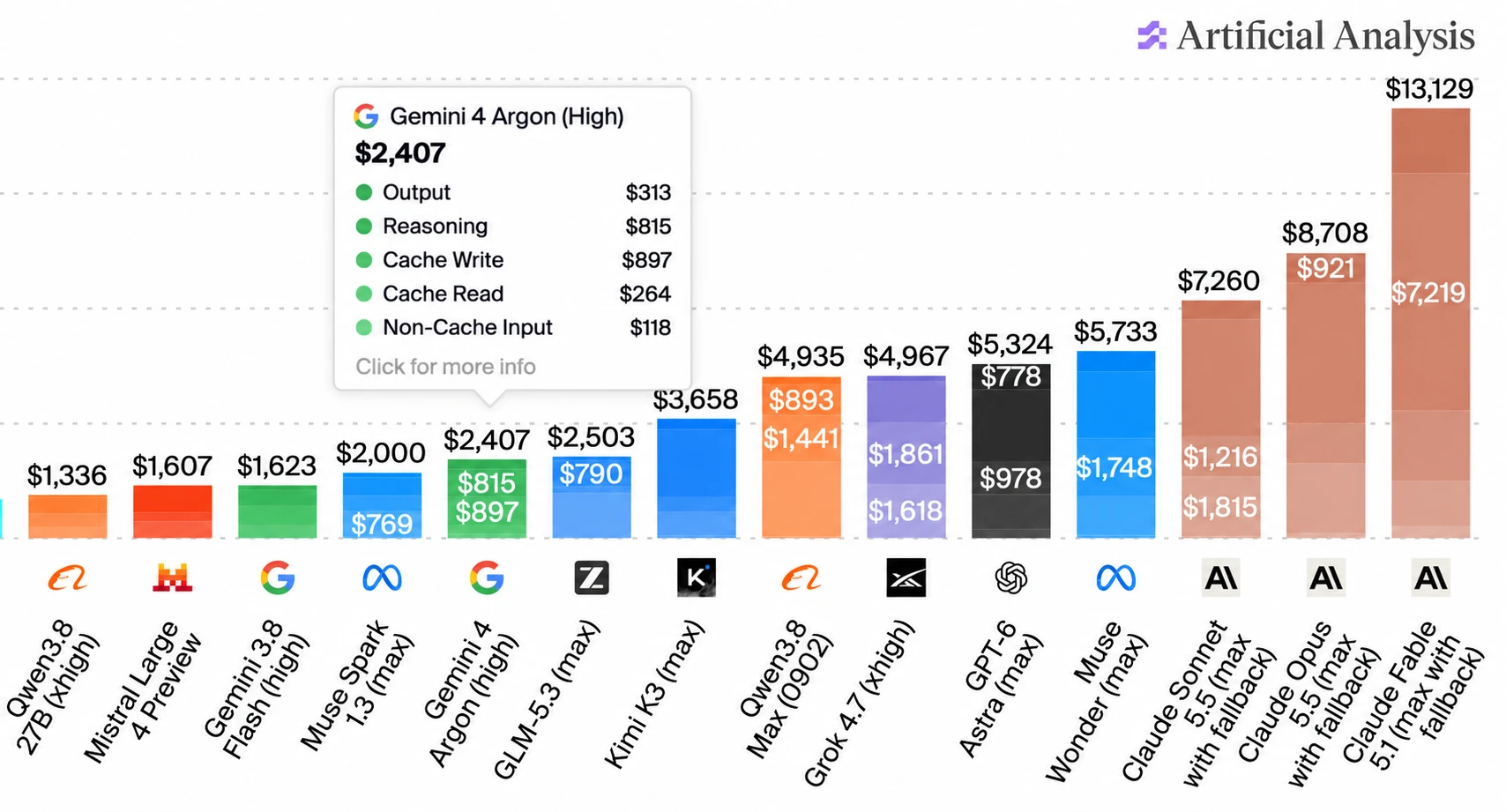
Evaluating raw token rates offers only a partial picture, making agentic workload efficiency crucial for practitioners. Data from Artificial Analysis shows that running their full evaluation benchmark with Argon costs $2,407. This total places it near GLM-5.3 while making it substantially cheaper to run than the latest flagship models from OpenAI, Anthropic, and Meta. Even after the scheduled December price increase, Argon's overall benchmark execution costs are projected to remain slightly lower than those of GPT-6 Astra.
For developers utilizing command-line LLM utilities, the updated plugin provides immediate access to test Argon's SVG capabilities and cost efficiency across automated workflows. The combination of strong multimodal rendering and low initial execution costs makes it an attractive option for high-volume agentic tasks before the December price bump takes effect.
This is our own summary of reporting by Simon Willison